- Call us 01444 237070

-
- Back
- Used Cameras
- Used Accessories
- Used Lenses
- Back
- Used Canon Lenses
- Used Nikon Lenses
- Used Fujifilm Lenses
- Used Sony Lenses
- Used Micro 4/3rds Lenses
- Used Leica Lenses
- Used Panasonic Lenses
- Used Pentax Lenses
- Used Samyang Lenses
- Used Sigma Lenses
- Used Tamron Lenses
- Used Tokina Lenses
- Used Voigtlander Lenses
- Used Zeiss Lenses
- Used Hasselblad Lenses
- Used Video
- Used Film Equipment
- Used Stock Alert
- Used Blank Test
- Sell or Part Exchange
- Used Clearance
- Recently Added Used Equipment
- Park Picks
- Faulty
- Trade-In
- Blog
- New in
- Call us
- Contact us
- Stores
- Sign in
Call us: 01444 237070
Search terms
Brands
Category
Products
[[{name}]]
[[{attributes.Price}]]
- Categories
- Tips & Inspiration
- Reviews
- News
- Events
- Features
- Buying Guides
- Competitions
Sigma Updates 35mm F1.4 and adds 15mm Lens
Since the arrival of the second-generation 24-70mm f/2.8 DG DN II Art back in May 2024, Sigma has been busy releasing updated mirrorless lenses alongside new prime and zoom options.
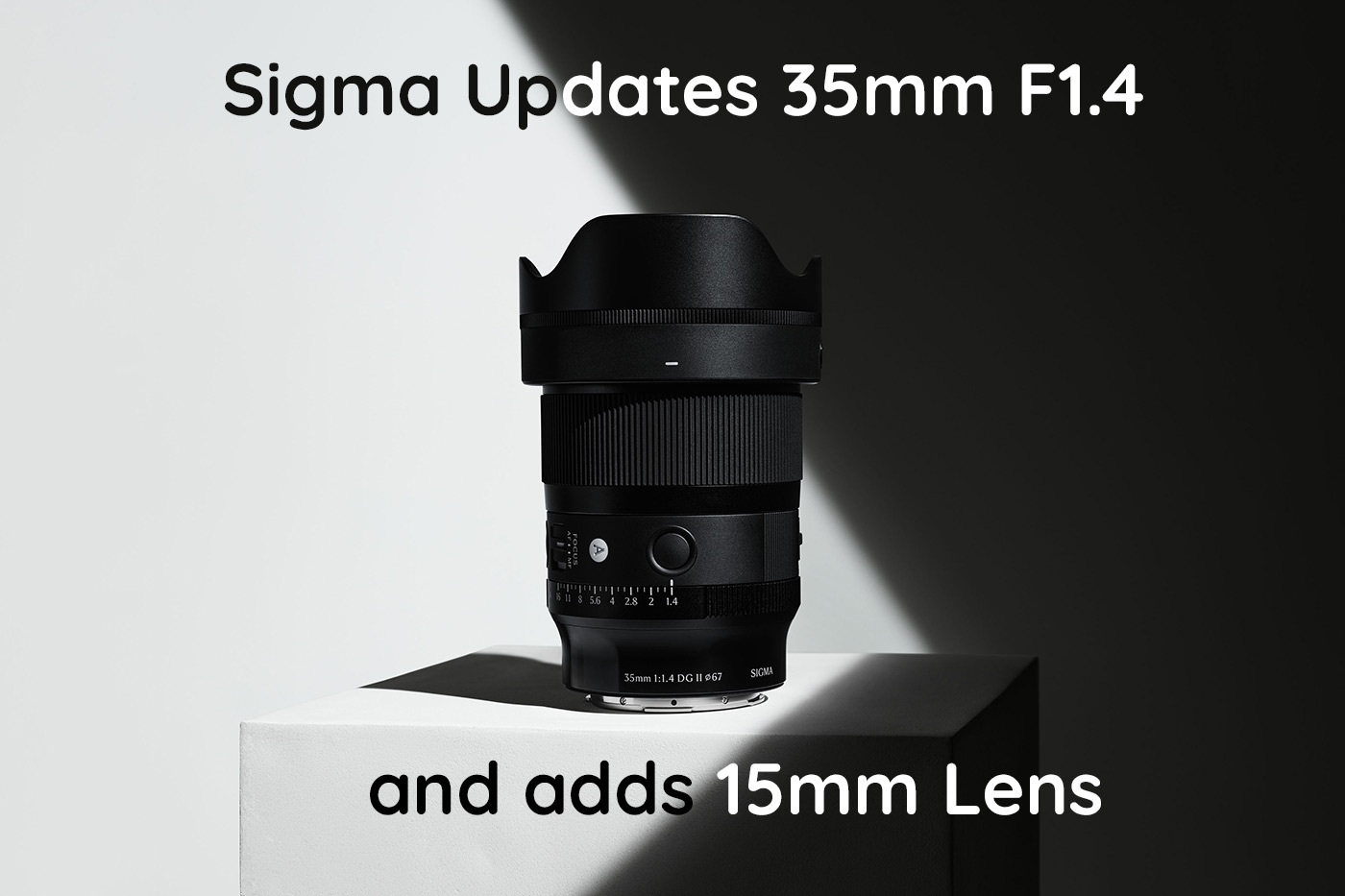
In February 2026, two new models arrive at once with the announcement of the next-generation 35mm f/1.4 DG II Art lens and the all-new 15mm f/1.4 DC Contemporary.
While the 35mm f/1.4 updates Sigma’s prestigious Art series, which is aimed at enthusiast and professional users, the 15mm f/1.4 provides APS-C camera newcomers and enthusiasts with a compact, lightweight ultra-wide prime for everyday storytelling.
Both are available in a variety of mounts. The 35mm full-frame lens is for Sony E-mount cameras and L Mount systems. The 15mm is for APS-C cameras and is available in Sony E mount, Canon RF and Fujifilm X mount.
In this quick first look review, we explore what’s new in the next Sigma 35mm f/1.4 and what you can expect from the all-new 15mm ultra-wide prime. So without further delay, let’s take a look pricing in the UK for these two new Sigma lenses.

Photographer Du Li Chao with the new lens
Sigma 35mm f/1.4 DG II Art and 15mm f/1.4 DC Contemporary Price
The table below shows the prices for these new Sigma options. Pricing is very competitive, with the 35mm accessible to advanced users who need a fast standard lens, while the 15mm is very approachable for the focal length and aperture it combines.
|
Model |
Price |
|
£849.00 |
|
|
£849.00 |
|
|
£449.00 |
|
|
£449.00 |
|
|
£449.00 |
Next we look at key specs at glance.

Sample 01 ©Du Li Chao with 35mm f/1.4 DG II Art. Camera settings: 1/250 sec. f/2.0. ISO 400
Key Specifications at a Glance
Below is a quick overview of the key specifications for both of these lenses. This gives you a sense of where they fit into Sigma’s line-up before we look more closely at what has changed and how each one fits into everyday use.
Sigma 35mm f/1.4 DG II Art
- Full-frame mirrorless prime
- 15 elements in 12 groups
- 11 rounded diaphragm blades
- Dual HLA autofocus system
- Minimum focusing distance 28cm
- 67mm filter thread
- Approx. 525g to 530g depending on mount
Sigma 15mm f/1.4 DC Contemporary
- APS-C mirrorless prime
- 11 elements in 13 groups
- 9 rounded diaphragm blades
- Stepping motor autofocus
- Minimum focusing distance 17.9cm
- 58mm filter thread
- Approx. 220g to 240g depending on mount
That’s all well and good, but what’s actually new in the 35mm II Art lens?

Sample 02 ©Du Li Chao with 35mm f/1.4 DG II Art. Camera settings: 1/160 sec. f/1.6. ISO 400
What’s New for the Sigma 35mm f/1.4 DG II Art Lens?
Sigma has updated the 35mm f/1.4 DG II Art lens inside and out, overhauling the optics, size, weight and handling. The table below compares the original with the newer model, so you can easily see what’s new. This is followed by a closer look at the updates that aren’t obvious from the specifications alone.
|
Specification |
35mm f/1.4 DG II Art (New) |
35mm f/1.4 DG DN Art |
|
Camera Type |
Mirrorless |
Mirrorless |
|
Corresponding Mount |
L-Mount, Sony E-mount |
L-Mount, Sony E-mount |
|
Sensor Format |
Full-frame [DG] |
Full-frame [DG] |
|
Lens Construction |
15 elements in 12 groups (including 2 SLD and 4 Aspherical Elements) |
15 elements in 11 groups (including 1 FLD, 1 ELD, 2 SLD and 2 aspherical elements) |
|
Angle of View |
63.4° |
63.4° |
|
Number of Diaphragm Blades |
11 (Rounded diaphragm) |
11 (Rounded diaphragm) |
|
Minimum Aperture |
F16 |
F16 |
|
Minimum Focusing Distance |
28cm |
30cm |
|
Maximum Magnification Ratio |
1:5.4 |
1:5.4 |
|
Focus system |
Dual HLA (High-response Linear Actuator) |
Inner focus system Stepping Motor |
|
Filter Size |
φ67mm |
φ67mm |
|
Dimensions (Diameter × Length) |
L-Mount:φ73mm × 94mm Sony E-mount:φ73mm × 96mm |
L-Mount:φ75.5mm × 109.5mm Sony E-mount:φ75.5mm × 111.5mm |
|
Weight |
L-Mount:530g Sony E-mount:525g |
L-Mount:645g Sony E-mount:640g |
|
Edition Number |
A026 |
A021 |
From this, we can see that the newer version is approximately 12% smaller, 20% lighter and offers faster focusing with a refined optical design. What is not immediately obvious from these specifications is that the optical formula has been revised to improve performance when shooting wide open.
Key Updates Include:
- Enhanced image quality when shooting wide open at f/1.4
- Reduced focus breathing for video focus pulls
- Amorphous Coating improves flare and ghosting resistance
- Redesigned mechanical structure alongside the new optical formula
Essentially, these refinements make the lens easier to work with, whether you shoot handheld photo and video content or use a tripod or gimbal stabiliser. This makes it a more versatile option not only for hybrid creators, but also for photographers who need to capture close-up images and rely on the best wide-open performance.
With a 35mm focal length and wide aperture this is a great option for low light subjects, and of course for everything from weddings and street photography to travel, portraits, snapshots and much more. We looked at why use a 35mm lens previously, which explores the types of subjects you can capture more broadly.

Sample 03 ©Elliot Aubin with 35mm f/1.4 DG II Art. Camera settings: 1/400 sec. f/1.4. ISO 1000
What Lens Controls are there?
As a pro-ready lens, it features comprehensive controls for more involved workflows. The two lenses are very similar despite the weight difference, with the newer model retaining the same ergonomics while offering improved performance.
- Aperture Ring: Both versions have a manual aperture ring.
- Aperture Ring Click Switch: Both the original and the DG II include a click ON/OFF switch for the aperture ring, with a de-click function.
- Aperture Ring Lock Switch: Both versions retain the aperture ring lock switch to prevent accidental rotation.
- AFL (Autofocus Lock / Custom Function) Buttons: Both models include AFL buttons.
- Focus Mode Switch: Both have a focus mode selector.
- Focus Behaviour (Linear vs Non-Linear, L Mount only): Linear and non-linear focus behaviour options for L Mount are available on both lenses.
- Autofocus Actuation System: The original uses a stepping motor autofocus system, while the new lens includes Sigma’s Dual HLA (High-response Linear Actuator).
Both lenses feature dust- and splash-resistant construction in line with Sigma’s Art series standards. They support DMF and AF+MF operation, and are compatible with subject detection autofocus on Sony E-mount and L Mount cameras.
Next let’s take a look at the all-new ultra wide for crop sensor cameras.

Sample 04 ©Elliot Aubin with 35mm f/1.4 DG II Art. Camera settings: 1/500 sec. f/1.4. ISO 800
A New APS-C Option with the 15mm f/1.4 DC Contemporary Lens
With the launch of the Sigma 15mm f/1.4 DC Contemporary, photographers of all levels gain a very portable and lightweight ultra wide-angle prime lens with an equivalent focal length of around 22mm / 24mm.
As mentioned earlier, it costs £449.00 for any of the mounts, which represents good value for this type of fast ultra-wide lens. But what is it for
What can you capture with a 15mm lens (approx. 22mm equivalent)
With an approximate 22mm equivalent focal length when mounted on an APS-C camera, this is suitable for subjects such as:
- Landscapes
- Travel photography
- Architecture and interiors
- Environmental portraits
- Street photography
- Vlogging and handheld video
- Commerce and webinars
- Night sky and astrophotography
- Documentary
- Group shots

Sample 05 ©Noriko Yamaguchi with 35mm f/1.4 DG II Art. Camera settings: 1/2000 sec. f/1.4. ISO 100
What’s the difference between Sigma Contemporary vs Art lenses?
If you’re new to Sigma lenses, you may be wondering what the difference is between a Contemporary and an Art lens. Essentially, Art lenses prioritise the highest optical performance and creative expression, making them suitable for artists and professionals.
The Contemporary range on the other hand, offers a more balanced approach to optical quality and portability, making it better suited to a wider range of everyday photography needs.
In the case of these two examples, the differences include the optical formula, which influences image quality, as well as size and weight, since the Art lens is noticeably bigger and heavier. There are also differences in autofocus and user controls, with more controls found on the Art lens barrel.
Of course, these two lenses are not directly comparable, as one is an ultra-wide and the other a standard focal length, but the comparison helps illustrate how each sits within Sigma’s lens range.

Sample 06 ©Noriko Yamaguchi with 35mm f/1.4 DG II Art. Camera settings: 1/200 sec. f/5.6. ISO 400
Who Are These Lenses For?
Sigma makes popular alternatives to camera manufacturers’ own-brand lenses, with a growing number of creators choosing Sigma lenses. In the case of these two models, the 35mm DG II is aimed at professionals who shoot weddings and other events, documentary and street photography, as well as hybrid creators who also capture video.
The 15mm on the other hand, suits new and established APS-C creators, travellers, video makers, astrophotographers and vloggers. It is also a good option for business users who need an ultra wide-angle lens for corporate work, including live commerce and webinars.
Both have their place, with the 35mm being one of the most influential focal lengths in modern photography, arguably rivalled only by the 50mm in importance over the years.
The updated Sigma 35mm f/1.4 DG II Art lens is more of an evolutionary refinement rather than a radical departure from the previous generation. This was already a fantastic lens, and Sigma has concentrated on making it even better through a reduction in size and weight, along with improved AF speed. The improvements to close-up shooting and wide open image quality are icing on the cake, ensuring that the Art range is as competitive as it ever was.
Meanwhile the addition of the 15mm f/1.4 DC Contemporary bolsters Sigma’s APS-C lineup. It targets a different user group, but brings an equally fast aperture and a much more compact size for wide angle subjects, including video.
Whether you prefer a 35mm lens for storytelling or the expansive perspective of an ultra-wide for your crop format camera, order a new Sigma lens and see where creativity takes you today.
Remember that you can trade-in your unwanted gear and use the money you make to offset against the price of new and used equipment from Park Cameras. Get a free instant quote today, and see how much you could save.
Share this post:
By Nick Dautlich on 24/02/2026

Nick Dautlich
Senior Content Writer and Product Reviewer
Nick Dautlich is the Senior Content Writer and Product Reviewer at Park Cameras, with over 15 years of photography experience. A Sony Imaging Professional and expert reviewer, Nick has worked with major brands such as Canon, Sony and Nikon. His work is also featured on Vanguard World UK’s website, Capture Landscapes, and Shutter Evolve. Nick’s photography includes National Trust projects and magazine covers and he is passionate about landscapes and storytelling. Nick also enjoys hiking and teaching his children about nature. Learn more on his profile page.
Trade in your old equipment
Fast and easy trade in service ensures your old gear is collected efficiently and you are paid quickly! It's very simple to trade in your unwanted photography gear. Just head over to our dedicated Sell or Part Exchange page, fill out the details, and we'll get back to you with an offer for your old gear. Take the cash, or put it towards the cost of your new gear. It's up to you! Find out more
sign up to the newsletter
Keep up to date on the latest photography news, events and offers. Sign up now