- Call us 01444 237070

-
- Back
- Used Cameras
- Used Accessories
- Used Lenses
- Back
- Used Canon Lenses
- Used Nikon Lenses
- Used Fujifilm Lenses
- Used Sony Lenses
- Used Micro 4/3rds Lenses
- Used Leica Lenses
- Used Panasonic Lenses
- Used Pentax Lenses
- Used Samyang Lenses
- Used Sigma Lenses
- Used Tamron Lenses
- Used Tokina Lenses
- Used Voigtlander Lenses
- Used Zeiss Lenses
- Used Hasselblad Lenses
- Used Video
- Used Film Equipment
- Used Stock Alert
- Used Blank Test
- Sell or Part Exchange
- Used Clearance
- Recently Added Used Equipment
- Park Picks
- Faulty
- Trade-In
- Blog
- New in
- Call us
- Contact us
- Stores
- Sign in
- Categories
- Tips & Inspiration
- Reviews
- News
- Events
- Features
- Buying Guides
- Competitions
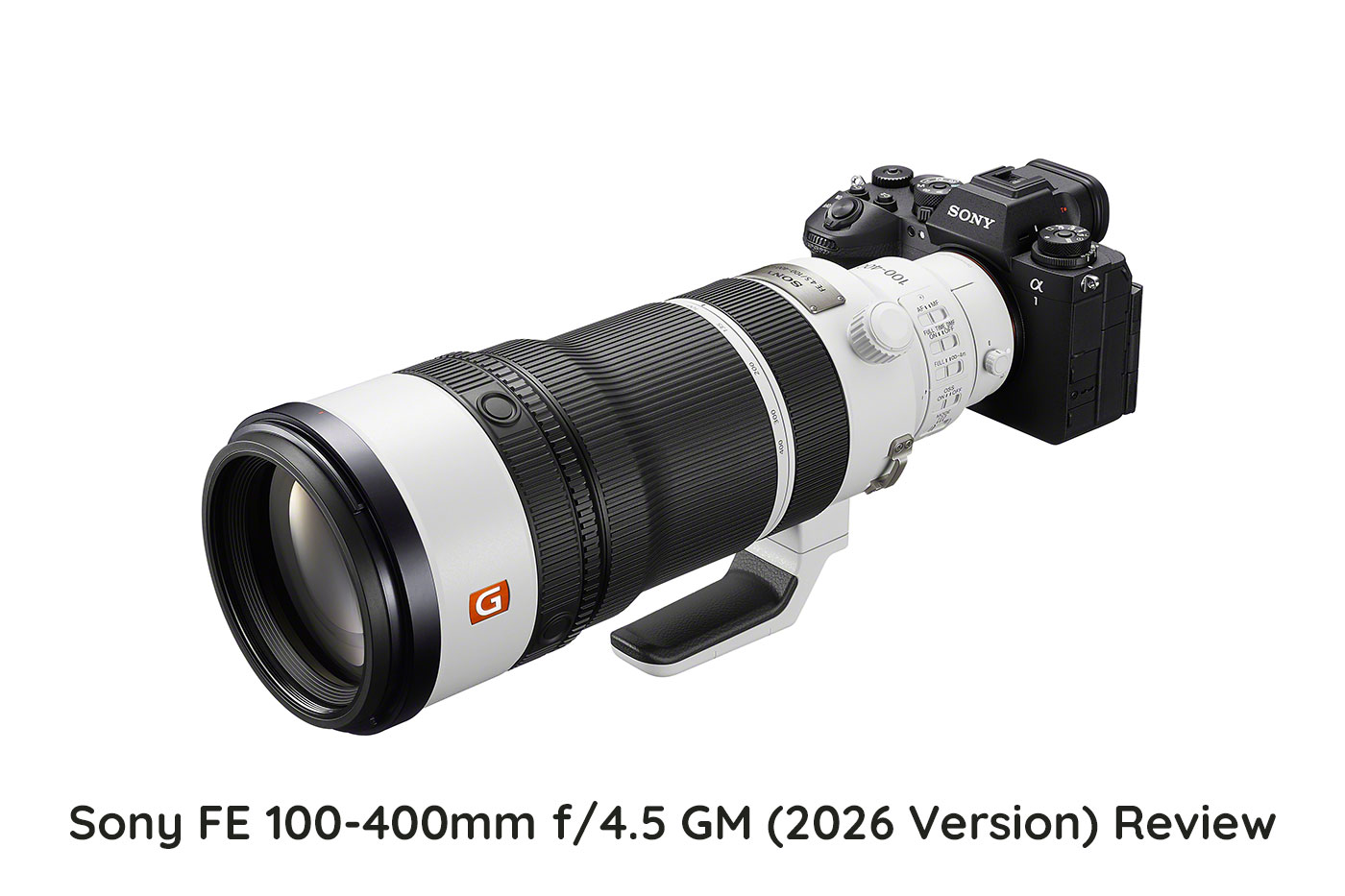
Sony FE 100-400mm f/4.5 GM 2026 Review
With an existing, very good quality 100-400mm G Master super-telephoto zoom lens currently available, you may be wondering what makes the new Sony FE 100-400mm f/4.5 GM OSS lens better?
Watch Gareth's Hands-on video review of the zoom lens here
However, a lot has changed since April 2017, when that original 100-400 GM lens was released. We know that Sony has a wealth of new and updated optical technology at their disposal since those early days of mirrorless glass, which we explore in this Sony FE 100-400mm f/4.5 GM 2026 Review.
Whether you are considering upgrading, or are new to this popular model, join us as we get to grips with the new super-telephoto zoom in a hands-on video, with plenty of sample images and a specs comparison compared to the original, so you can see which might be best for your needs.
Let's dive right in, beginning with the release date and price, which will be one of the first questions on potential buyers' minds.
Release date and UK price
This model costs £4,400.00 at launch, and was released on 13th May 2026. This is more than double the price of the original GM version, which currently retails at £2,149.00. So what does this new everyday super-telephoto zoom deliver for the price?

Does the 2026 version have a constant aperture?
Yes! The first thing you'll notice is that the new model has a constant aperture. It is an f/4.5 lens throughout the whole range, whereas the first model is a variable f/4.5-5.6 aperture. That's a difference of around 0.7 stops of light.
The constant aperture is perhaps best thought of as allowing you to maintain exposure throughout the zoom range, rather than looking at it as just a 0.7-stop advantage. It means you can track subjects without needing to think about exposure as you zoom, which saves a step when working fast.
But there's more, light gathering isn't the only improvement.

Why are 100-400mm lenses so popular?
This zoom range is available in virtually every camera mount. In the case of the Sony, there are several 100-400mm lenses available, so what makes it so popular?
To begin with, these are typically quite affordable. Photographers who aspire to capturing distant subjects, such as outdoor sports, wildlife and action, can try their hand and confidently achieve great results before investing heavily.
It's also a very versatile range. You can capture more than just relatively distant subjects, including portraits, landscapes, events, photojournalism and lifestyle.
The weight is also generally quite manageable, allowing you to hike, scope shots and walk to destinations without your kit being too heavy.
These are all valid points in comparison to professional super-telephoto lenses, which can cost five figures and often weigh significantly more.
So 100-400mm is versatile, affordable and manageable, while delivering good quality results.
With that said, let's get back to the new model, and what it brings to the party.

What’s new?
Aside from offering a fixed aperture, which gathers more light, how does the new model ens set itself apart from the original? It does so in a number of ways, and key features include:
- An internal zoom design, so the length does not extend
- New AF control algorithms
- Four XD Linear Motors for up to 3x faster focusing
- Up to 120fps AF tracking support
- Extremely advanced optical design for higher image quality
- Improved bokeh quality
- An 11-blade circular aperture
- Nano AR Coating II
- Shorter overall length when older model is extended
- Dual 95mm threaded filters and 45mm rear drop-in system
The combination of these upgrades improves your chances of capturing the defining moment across difficult shooting situations, such as:
- During unpredictable movement
- Where the subject is small within the frame
- Where instant response is required
- For high speed action and tracking
- In darker environments or with more limited space
While these features improve operation and image quality, Sony has also carried across many of the most valuable capabilities from the original, including:
- Compatibility with 1.4x and 2.0x teleconverters for a maximum 800mm reach
- The inclusion of Super ED and ED glass elements
- Excellent tele-macro capabilities for close focusing with high magnification
- Zoom torque switch, with smooth and tight response
- Fluorine coating
- Dust and moisture resistance
This results in a better all-rounder. It's slightly shorter, faster, more accurate and delivers even better image quality with more light gathering.

Specs comparison
The specifications table below highlights the key differences between these two options.
|
|
||
|
Focus system |
Double linear motor with a Direct Drive Supersonic Motor (DDSSM) system |
4x XD Linear motors |
|
Lens Groups / Elements |
16 / 22 |
20 / 28 |
|
Special elements |
|
|
|
Lens coatings |
Nano AR coating Fluorine |
Nano AR coating II Fluorine |
|
Maximum Aperture |
f/4.5-5.6 |
f/4.5 |
|
Minimum Aperture |
f/32-40 |
f/32 |
|
Aperture Blades |
9-blade |
11-blade |
|
Circular Aperture |
Yes |
Yes |
|
Minimum Focus Distance |
0.98m |
0.64-1.5m |
|
Maximum Magnification |
0.35x |
0.25x |
|
Filter Diameter |
77mm |
95 / 40.5mm (Drop-in filter) |
|
Image Stabilisation |
Optical SteadyShot |
Optical SteadyShot |
|
Internal Zoom System |
No |
Yes |
|
Teleconverter Compatibility |
Yes |
Yes |
|
Function ring |
No |
Yes |
|
Security slot |
No |
Yes |
|
Dust and moisture resistant |
Yes |
Yes |
|
Dimensions |
93.9 × 205mm |
119.8 x 328mm |
|
Weight |
1395g |
1840g |
There's no question that the newer model is more capable, but this does not detract from the original, which is still an excellent option, that is suitable for many users. But which should you choose?
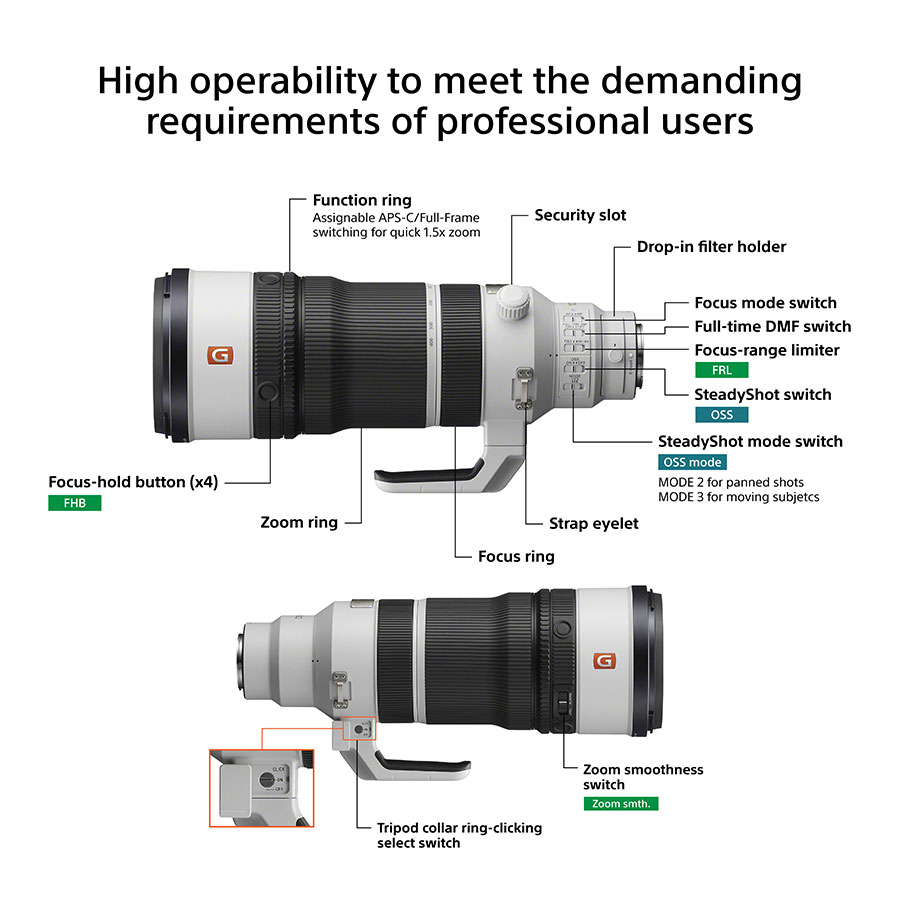
Lens controls image supplied by Sony
Which version is for you?
The newer model provides several key advantages over the original, which make it better suited to professional use. If you frequently have to get specific shots, or work trackside or behind a fence during motorsports, it will provide a better chance of capturing what you need.
It's better equipped for tracking smaller subjects, and retains focus on erratical movement better too. If you shoot with one of the premium bodies, like an A9 III or A1 II, you’ll also be able to keep up with 120fps burst rates and 4K HFR. When these are primary concerns, whether you're an enthusiast or a professional, this would be the one to choose.
For less demanding situations, where you want a lighter setup, or where you don't need the absolute fastest AF available, the original will probably meet your needs. It still provides many of the benefits of a versatile super-telephoto, is compatible with teleconverters, and achieves excellent image quality and is very good for close-ups.
Whether you’re interested in bird photography, professional sports and action, or wildlife, landscapes, events and more, there’s now a Sony lens that better suits your needs, and budget.

Shop for the new Sony FE 100-400mm f/4.5 GM OSS Lens to experience the very latest telephoto performance, or browse for the original FE 100-400mm f/4.5-5.6 GM OSS, which is still an extremely capable and versatile option.
This launched alongside the latest generation A7R VI camera, which is no coincidence. You can read more about that here in our A7R VI Review and Specs Comparison.
Share this post:
By Nick Dautlich on 13/05/2026

Nick Dautlich
Senior Content Writer and Product Reviewer
Nick Dautlich is the Senior Content Writer and Product Reviewer at Park Cameras, with over 15 years of photography experience. A Sony Imaging Professional and expert reviewer, Nick has worked with major brands such as Canon, Sony and Nikon. His work is also featured on Vanguard World UK’s website, Capture Landscapes, and Shutter Evolve. Nick’s photography includes National Trust projects and magazine covers and he is passionate about landscapes and storytelling. Nick also enjoys hiking and teaching his children about nature. Learn more on his profile page.
Trade in your old equipment
Fast and easy trade in service ensures your old gear is collected efficiently and you are paid quickly! It's very simple to trade in your unwanted photography gear. Just head over to our dedicated Sell or Part Exchange page, fill out the details, and we'll get back to you with an offer for your old gear. Take the cash, or put it towards the cost of your new gear. It's up to you! Find out more
sign up to the newsletter
Keep up to date on the latest photography news, events and offers. Sign up now