- Call us 01444 237070

-
- Back
- Used Cameras
- Used Accessories
- Used Lenses
- Back
- Used Canon Lenses
- Used Nikon Lenses
- Used Fujifilm Lenses
- Used Sony Lenses
- Used Micro 4/3rds Lenses
- Used Leica Lenses
- Used Panasonic Lenses
- Used Pentax Lenses
- Used Samyang Lenses
- Used Sigma Lenses
- Used Tamron Lenses
- Used Tokina Lenses
- Used Voigtlander Lenses
- Used Zeiss Lenses
- Used Hasselblad Lenses
- Used Video
- Used Film Equipment
- Used Stock Alert
- Used Blank Test
- Sell or Part Exchange
- Used Clearance
- Recently Added Used Equipment
- Park Picks
- Faulty
- Trade-In
- Blog
- New in
- Call us
- Contact us
- Stores
- Sign in
- Categories
- Tips & Inspiration
- Reviews
- News
- Events
- Features
- Buying Guides
- Competitions
UK Astrophotography Highlights March 2026
Images ©Jonathan Penberthy
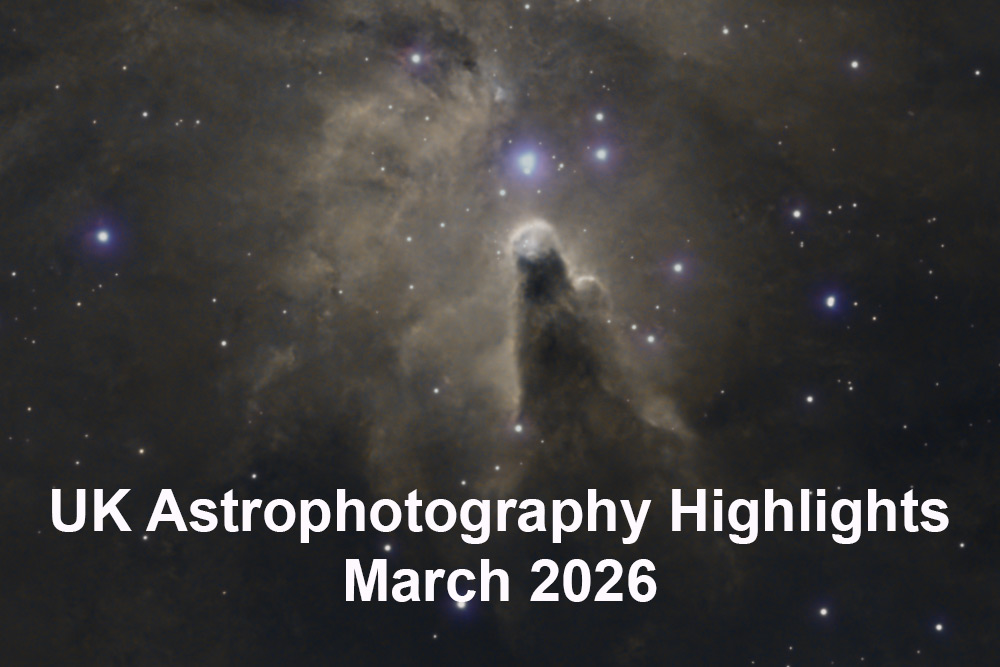
Well I never thought I would say this, but again this month we have been weaving our way through the gaps in the clouds to see the wonders over head.
NASA have re-scheduled Artemis II launch to 6th March (at the earliest), further information about the flight can be seen here.
If you wish to read about imaging this event then please check out last months blog here.
Last Months Challenge.
Well for obvious reasons I wasn't able to make the flight to the moon attempt, so this shall be my challenge this month. But don't think for a second I let myself off... instead I thought I would try and image the Dolphins Head Nebula.
As you may suspect SH2-308 isn't a target usually associated with UK skies as it peaks at around 15 degrees in our night sky, which basically is in the mark zone of light pollution, and as this Wolf-Rayet star is surrounded with OIII it really struggles to cut through, and if anything this is an example of why this target unless you have some very narrowband 0III filters like 3nm, it shouldn't be attempted. I gave it a go anyway with the L eNhanced filter.
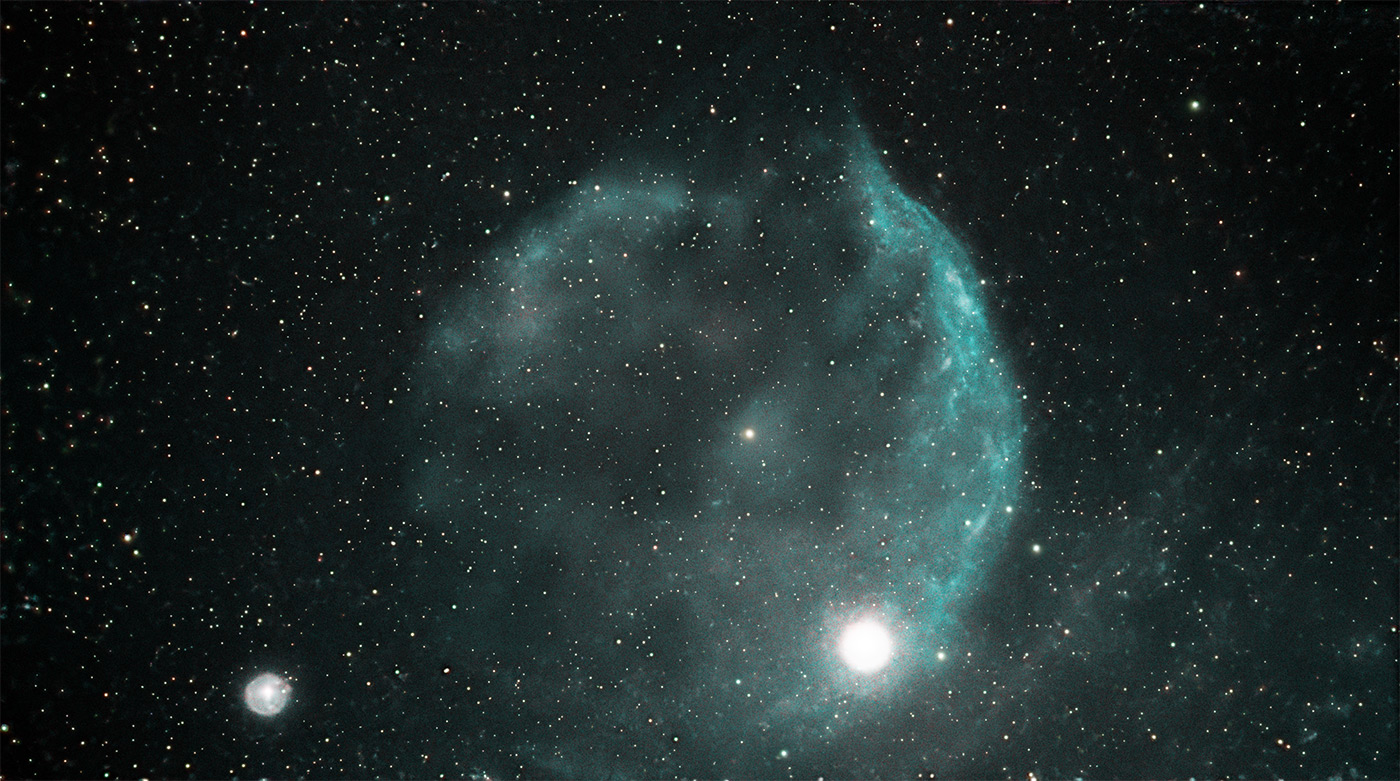
Camera: ZWO ASI585MC Pro.
Telescope: Altair Astro 70ED Telescope (420mm).
Mount: Sky-Watcher EQ5 Pro
Filter: Optolong L eNHance
Guide Camera: ZWO ASI120mm-s
Guide Scope: SVBony 30mm (f4)
Computer: ZWO ASIAIR pro
Method:
Lights: 60 x 120s -10 degrees celsius, gain 252.
Darks: 0
Flats: 0
Bias: 0
If you wish to read more about trying to capture and process these faint targets high in OIII please check out these blogs:
Deep Sky
The Horsehead and Flame Nebula (IC434)
As you may remember from last month, and the previous to that I have been working towards a mosaic of the Horsehead and Flame Nebula in Orion (IC434).
Sadly due to the rain I haven't been able to add as much data as I was intending, and due to the fact that Orion is now setting at 0100 in late February it is unlikely I will be able to add much more to this this winter, unless that is we have 10 clear nights in a row! So here is my 'final' composition mosaic which is made from 12 hrs total imaging time, and about 8 hrs usable data, 4 panels in the mosaic, cropped to remove artefacts and other issues.
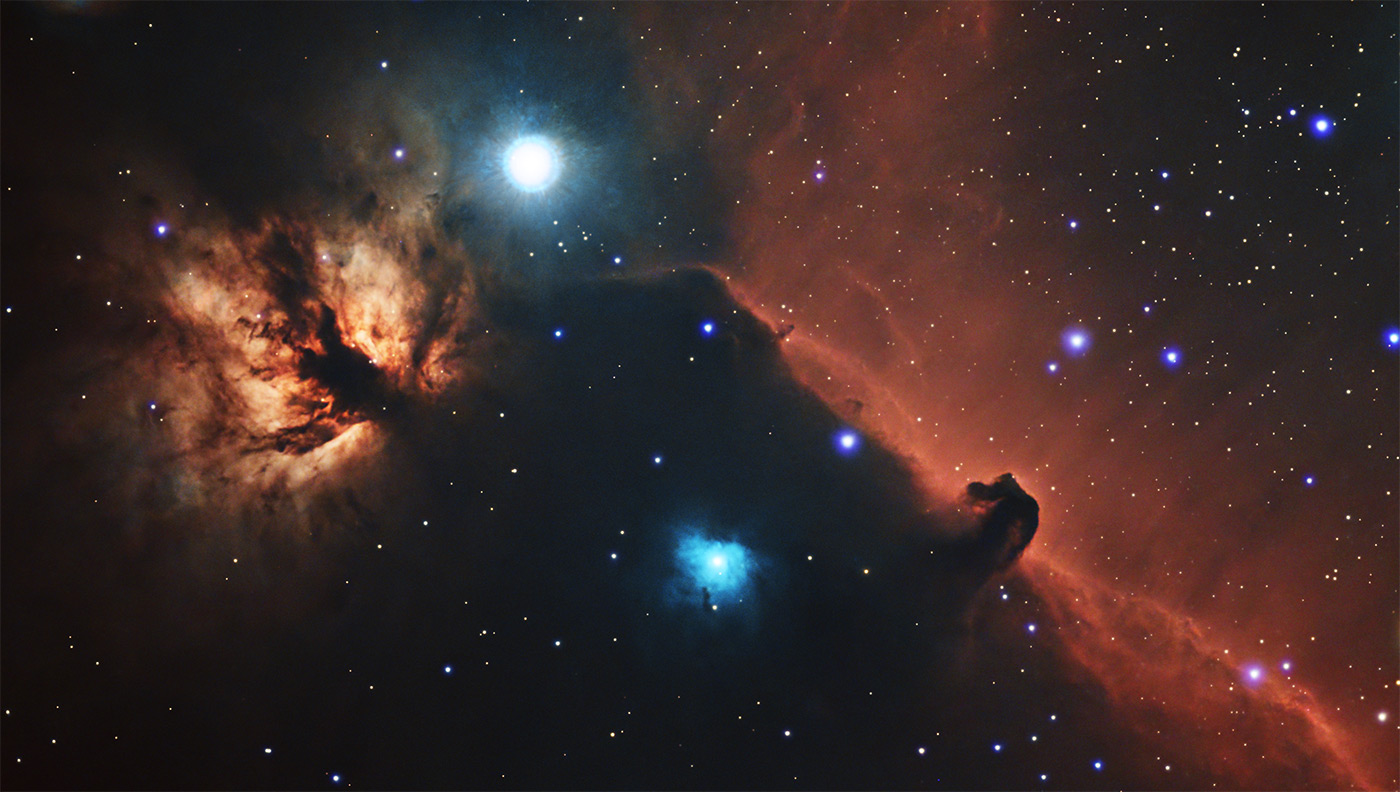
Exif
Camera: ZWO ASI585MC Pro.
Telescope: Altair Astro 70ED Telescope (420mm).
Mount: Sky-Watcher EQ5 Pro
Filter: Optolong L eNHance
Filter: (10 x 30 seconds for stars) UV/IR Cut
Guide Camera: ZWO ASI120mm-s
Guide Scope: SVBony 30mm (f4)
Computer: ZWO ASIAIR pro
Method:
Lights: 240 x 120 sec Gain 252.
Darks: 0
Flats: 0
Bias: 0
Stacked in DSS, Processed in Pixinsight with RC-Astro Suite of tools. Finishing touches in Photoshop.
You can read about capturing the Horsehead here.
M78 - 'Casper the Friendly Ghost Nebula'
M78 is a reflection nebula tucked into the Orion Molecular Cloud, not far from the famous Orion Belts belt and the Horsehead / Flame nebula mentioned above. What makes it stand out is the way its young, energetic stars illuminate the surrounding dust, turning the nebula into a soft glow against a backdrop of darker, colder material. Instead of shining by its own light, M78 acts like a cosmic mirror, scattering starlight through a cloud that’s still actively forming new stars. Dark lanes cut across the nebula where the dust is thickest, giving it a textured, almost sculpted appearance. It’s one of the closest and most accessible examples of early stellar evolution.
These reflection nebulae are tough to image, you make think this is half done, and you are correct, there is a lot more to add, but in order to do so well we need 3 things:
- No moon.
- Dark Sky Location.
- No or UV/IR cut filter.
- Long imaging window.
In this case I was planning a long night of imaging, however this was stollen from me by cloud, and of course if I get a chance to add more data I will, but for now I think this image gives a clear insight into the magic that this region in the Orion constellation exhibits.
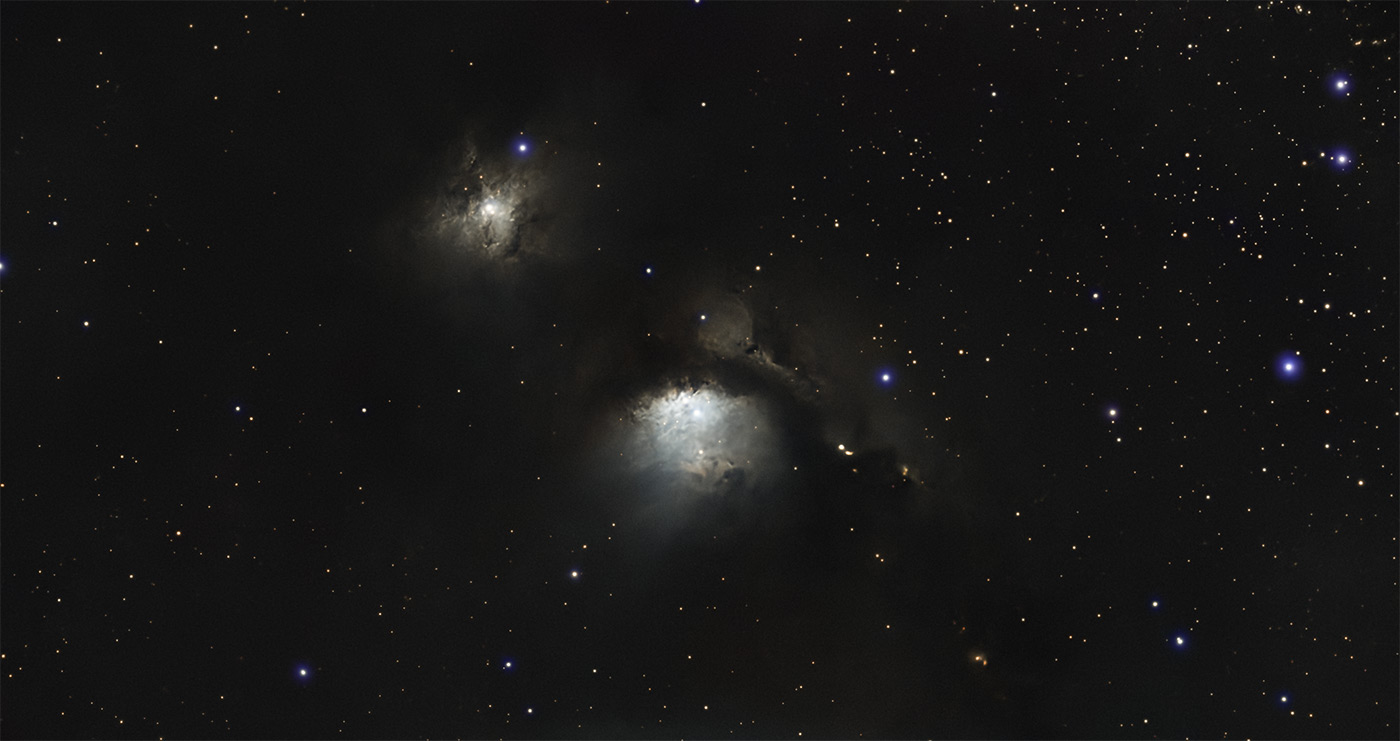
Exif
Camera: ZWO ASI585MC Pro.
Telescope: Altair Astro 70ED Telescope (420mm).
Mount: Sky-Watcher EQ5 Pro
Filter: UV/IR cut filter
Guide Camera: ZWO ASI120mm-s
Guide Scope: SVBony 30mm (f4)
Computer: ZWO ASIAIR pro
Method:
Lights: 45 x 120 sec Gain 252.
Darks: 0
Flats: 0
Bias: 0
Stacked in DSS, Processed in Pixinsight with RC-Astro Suite of tools. Finishing touches in Photoshop.
Thor's Helmet NGC 2359, Sh2‑298
Thor’s Helmet is one of those nebulae that looks like it was sculpted for mythology. A massive, hot Wolf-Rayet star sits at its centre, blasting out fierce stellar winds that inflate the surrounding gas into a bubble with sweeping arcs and wing‑like extensions. Under long exposure it takes on the shape of a glowing blue-green helmet, as if a cosmic shockwave froze mid‑motion. The whole structure is dynamic and turbulent, shaped by radiation powerful enough to carve cavities in the interstellar medium. It’s dramatic, energetic, and unmistakably heroic — a nebula that feels like it’s wearing its own armour.
This is another one of those wonders from the Sharpless Catalogue, and like the Dolphins Head it can prove tricky to image, the key here is that it appears much higher in our night sky and so with only a few hours data you can get a good result, well in my opinion at least!
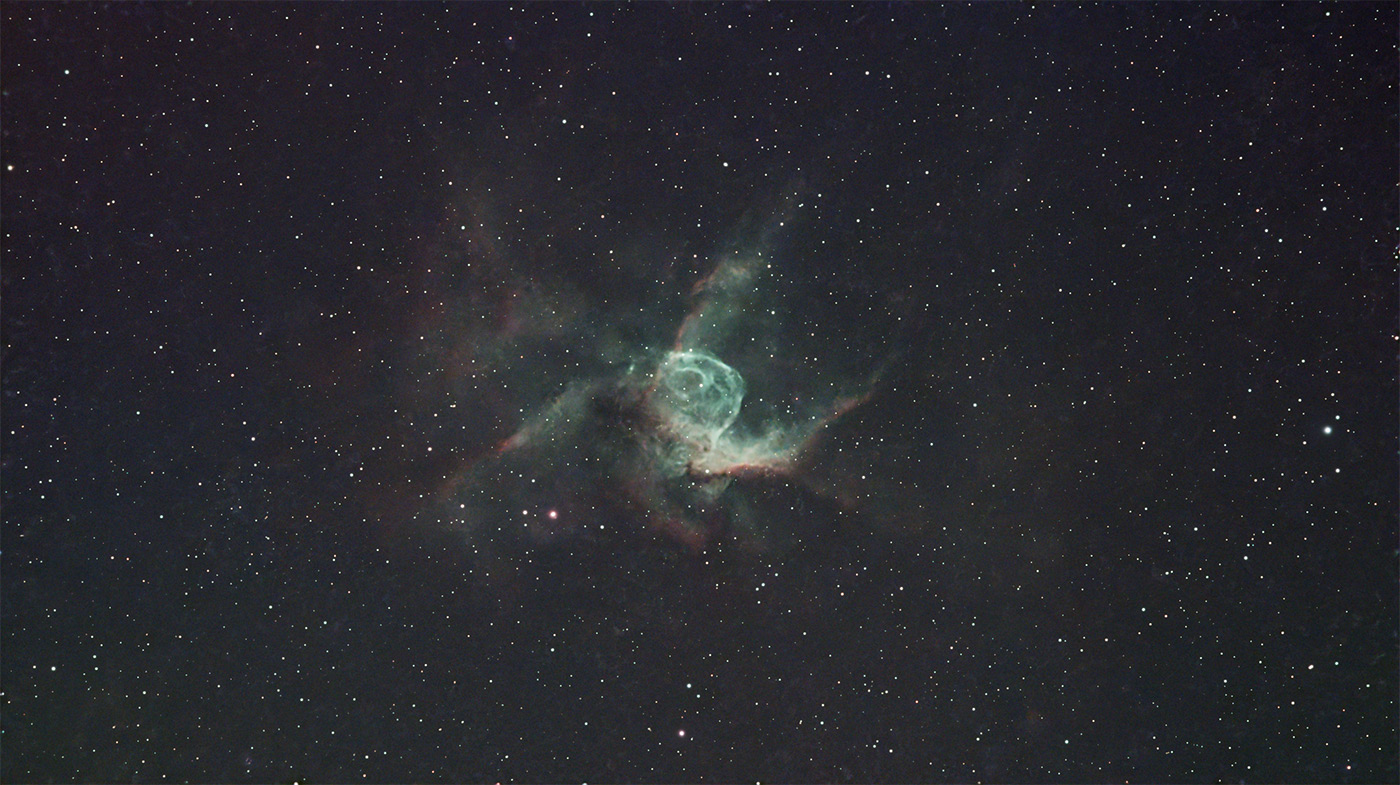
Camera: ZWO ASI585MC Pro.
Telescope: Altair Astro 70ED Telescope (420mm).
Mount: Sky-Watcher EQ5 Pro
Filter: Optolong L eNHance
Guide Camera: ZWO ASI120mm-s
Guide Scope: SVBony 30mm (f4)
Computer: ZWO ASIAIR pro
Method:
Lights: 40 x 120 sec Gain 252.
Darks: 0
Flats: 0
Bias: 0
Stacked in DSS, Processed in Pixinsight with RC-Astro Suite of tools. Finishing touches in Photoshop.
Cone Nebula - NGC 2264
The Cone Nebula looks like a dark, sculpted tower rising out of a glowing red cloud, as if carved by some slow, cosmic wind. What you’re really seeing is a dense column of cold gas and dust being eroded by the fierce radiation of nearby young stars. Their light illuminates the surrounding hydrogen, giving the region its deep crimson glow, while the pillar itself stays dark and textured, like a silhouette against a sunrise. It’s part of the much larger Christmas Tree Cluster region in Monoceros, and it captures a moment in the life of a star‑forming cloud where creation and destruction are happening side by side. The Cone feels both delicate and powerful — a reminder that even the quietest shapes in the sky are shaped by immense forces.
I was inspired by the Very Large Telescopes image of this wonder taken to celebrate the 60th anniversary of ESO back in 2022. You can see theirs here. Obviously they are in a different league to me, but it is interesting to read about how they achieved it. As you can see my tribute could well benefit from a few more hours data, and in time I will seek to do that. I have been obsessed recently with imaging the nebula itself using the l eNhance filter and then the stars using a UV/IR Cut filter. Then switching out the stars in my workflow so that you see the image with the real colours of the stars. In this particular image I have also run my 'Instant_HOO' script (Pixinsight, PixelMath) against it before adding the stars. We can see the shortcomings in my script in that the sulphur and oxygen regions in the VLT image have different hues than in mine, so I need to work on my script a bit more, but aside from both images having fake colours, I am happy with how mine turned out.
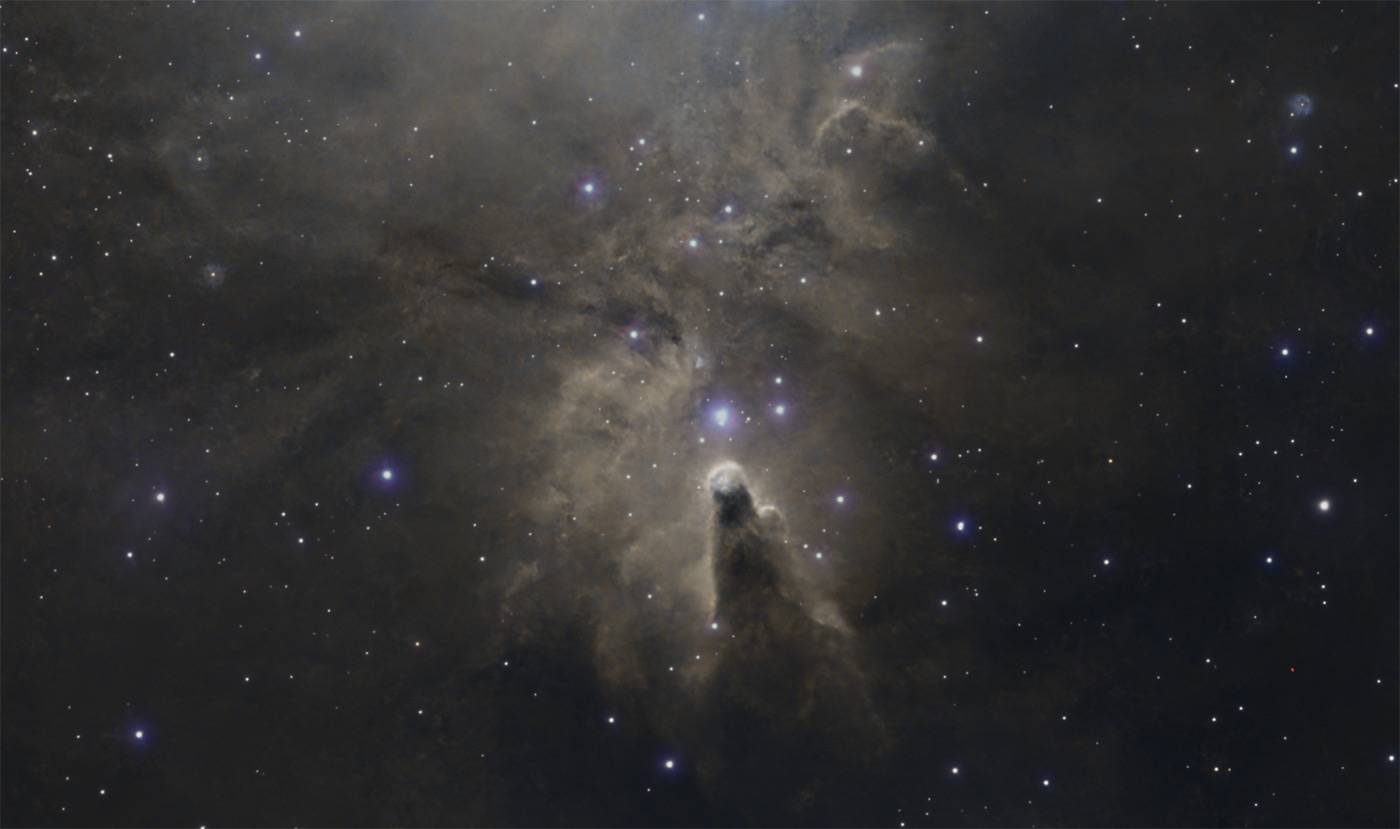
Camera: ZWO ASI585MC Pro.
Telescope: Altair Astro 70ED Telescope (420mm).
Mount: Sky-Watcher EQ5 Pro
Filter: Optolong L eNHance
Filter: (10 x 30 seconds for stars) UV/IR Cut
Guide Camera: ZWO ASI120mm-s
Guide Scope: SVBony 30mm (f4)
Computer: ZWO ASIAIR pro
Method:
Lights: 40 x 120 sec Gain 252.
Darks: 0
Flats: 0
Bias: 0
Stacked in DSS, Processed in Pixinsight with RC-Astro Suite of tools. Finishing touches in Photoshop.
Share this post:
By Jonathan Penberthy on 27/02/2026

Jonathan Penberthy
Cosmic Shutter Seeker and Star Programmer
Jonathan Penberthy is the Cosmic Shutter Seeker and Star Programmer at Park Cameras, with over 20 years of experience as a software engineer. His career journey has spanned industries, but a move to Park Cameras sparked a passion for astrophotography. Jonathan’s interest began while working on a lens selection app, leading him to explore the night sky with a Canon 7D. When he’s not programming or photographing the stars, he enjoys sailing and navigating by the cosmos. Learn more on his profile page.
Trade in your old equipment
Fast and easy trade in service ensures your old gear is collected efficiently and you are paid quickly! It's very simple to trade in your unwanted photography gear. Just head over to our dedicated Sell or Part Exchange page, fill out the details, and we'll get back to you with an offer for your old gear. Take the cash, or put it towards the cost of your new gear. It's up to you! Find out more
sign up to the newsletter
Keep up to date on the latest photography news, events and offers. Sign up now